Abstract
Space-based solar power (SBSP) is a potentially world-changing technology enabling the delivery of near-unlimited solar energy from space to almost anywhere on Earth. The realization of this technology could play a key role in ending global energy scarcity and inequality. However, efforts to develop SBSP have primarily been proprietary, and the technology raises dual-use concerns for the ability to use its capabilities in ways contrary to the public good. Project Elara is a nonprofit initiative to develop the world’s first 100% open-source space-based solar power system. As a proof-of-concept for space-to-Earth power transmission, the Project is developing a novel technology demonstrator with a free-electron maser (microwave laser) and a deployable solar mirror. We discuss the research and development we have conducted in diverse fields to develop this prototype, including computational physics, high-performance computing, computer modelling, and embedded hardware. We aim for this research to be as accessible and publicly-available as possible, in the hope that it will bring us closer towards a new era of not-for-profit space-based solar energy.
High-level overview
Project Elara (meaning “hope”) is a research organization dedicated to developing advanced open-source technologies for a global commons, dedicated to making a better future possible. Our primary research is in the development of space-based solar power; that is, energy harvesting with large-scale space-based solar power constellations. Achieving this capability would provide a stable, lasting energy source orders of magnitude more powerful than any contemporary or near-future capabilities.
Such a system would be able to practically eliminate energy shortages and reach essentially any location on Earth, and as it does not rely on power grids, it can provide power to remote regions, in the midst of natural disasters, and even in war zones. Moreover, this energy generation capacity is not tied to a specific geographic location and requires no fuel of any kind, instead relying on the Sun, an unlimited source of energy that will never go dark. We believe that developing space-based solar power technology in a collaborative effort, spearheaded by open science and open-source, can lead towards a truly peaceful and equitable future.
The development of such a system does not merely enable space-based solar power. Various near-term technologies would also be greatly benefitted by the successful development of this technology, including improvements in high-speed internet, satellite communications, laser surgery, high-precision interferometry, particle accelerators, and improvements in both inertial confinement and magnetic confinement fusion[1].
The present work of the Project is incremental and small-scale, with the aim of achieving more with time. We are focused on several milestone technologies in the path to space-based solar power: ultra-long-distance microwave transmission, power satellites, and wireless power receivers.
Technical description of research
Project Elara’s multidisciplinary research involves the development of:
Lightweight, non-rigid solar mirrors for solar focusing
A novel solar-pumped free-electron maser (microwave laser) for power beaming using microwaves
A low-cost satellite designed to house the solar mirror and power transmission maser
Power receivers for microwave power reception, including easily-manufactured power collection rectennas
Each component serves a critical role in our open-source space-based solar power system. Solar mirrors are a low-tech and cheaper alternative to photovoltaic (PV) panels featured in most space-based solar power proposals. Arranged in a parabolic shape, space-based mirrors concentrate and focus sunlight much like existing solar thermal technology. However, unlike the latter, the focused sunlight is then utilized to optically-pump a free-electron maser that efficiently converts incident solar energy into a microwave beam. Finally, terrestrial power receivers convert the beamed power back to electricity for local use or for distribution to electrical grids. This open-source system is designed to be robust, operate reliably in all weather conditions, and to be easy to manufacture, using primarily consumer-grade electronics and 3D-printed parts.
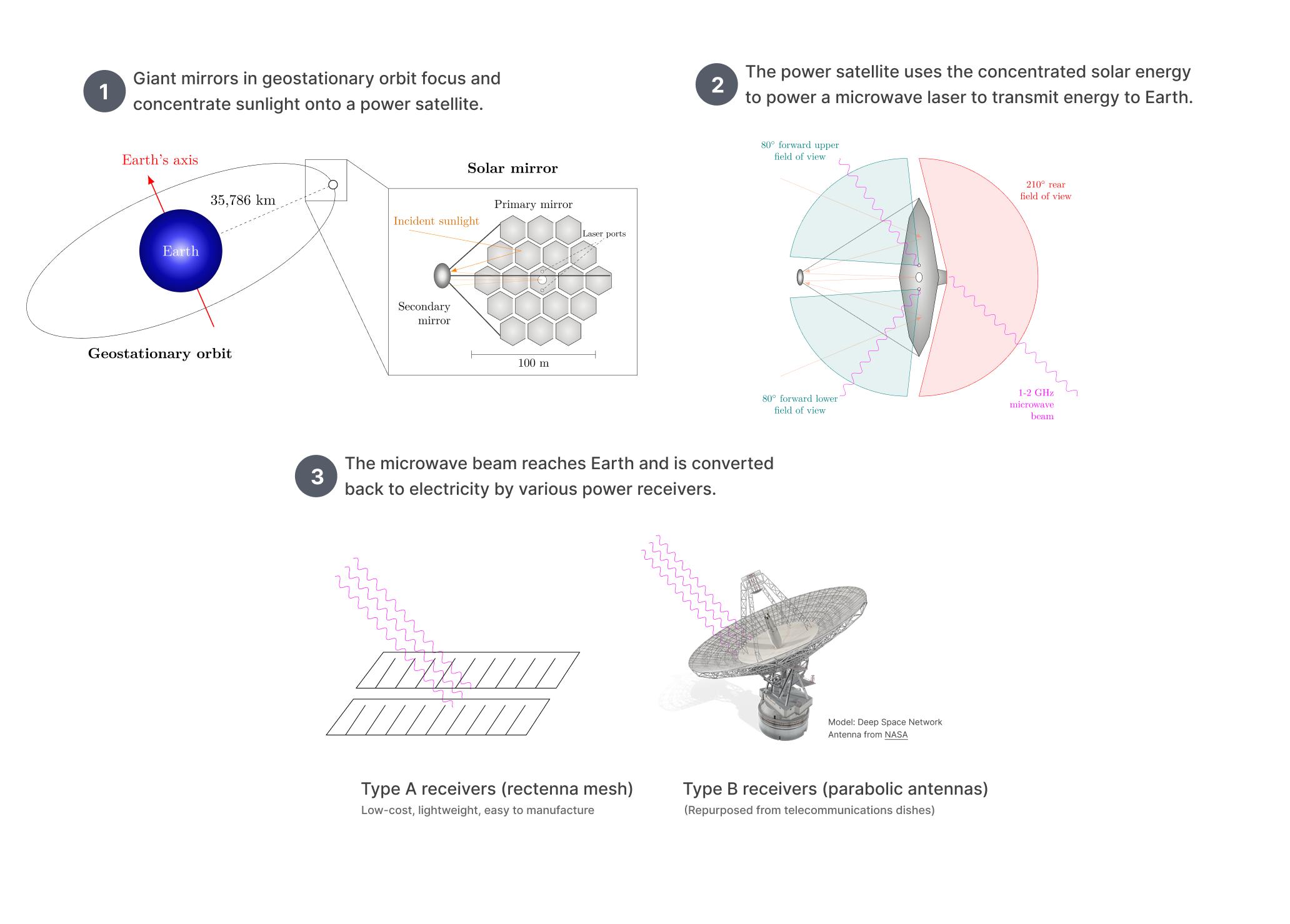
Figure 1:A diagram of the power system concept, depicting its various components.
Free-electron maser development
A free-electron maser forms the basis of power transmission in the system. The Faraday maser, developed by Project Elara, is a novel tunable free-electron maser designed for UHF microwave transmission. While presently not substantially explored in the field of space-based power transmission, free-electron masers are known for their high power output Urbanus et al., 2001 and high efficiency Ginzburg et al., 2000, characteristics ideally-suited to power transmission in space-based solar power. Moreover, free-electron masers in the microwave regime have already shown successful operation in the 1 GHz regime Drori et al., 1996, a frequency ideally-suited to power transmission due to its minimal atmospheric attenuation ITU-R, 2022.
Within our design, a 2 keV electron beam is focused using a magnetic lens, then injected into an undulator with alternating dipole magnets. Mirrors on either side of the undulator create a resonant field within the undulator. Pondermotive interactions between the radiative field and the electrons in the beam result in microbunching, leading to coherent emission of microwaves. The electron beam is created with an electron gun utilizing electrostatic acceleration, using a DC boost converter to step up a ~3 V power source to 2 kV, resulting in very low power consumption. The undulator acts as a passive resonator and is entirely unpowered, using permanent magnets to avoid the need for electromagnets. The entire design involves no mechanical parts, reducing risk of fatigue and structural failure, a characteristic essential for long-term space-based operation.
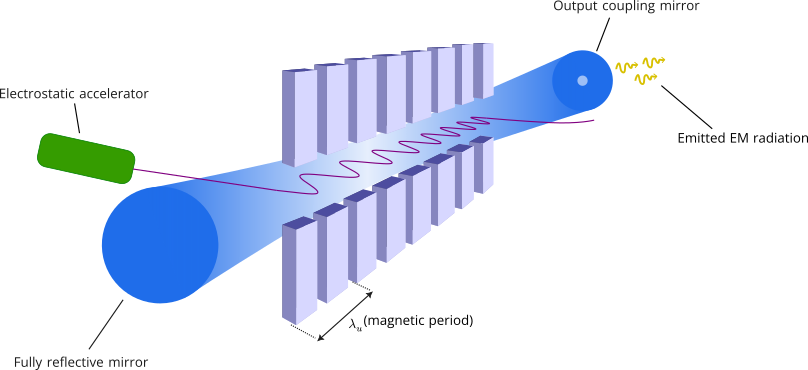
(a)Diagram of a free-electron laser
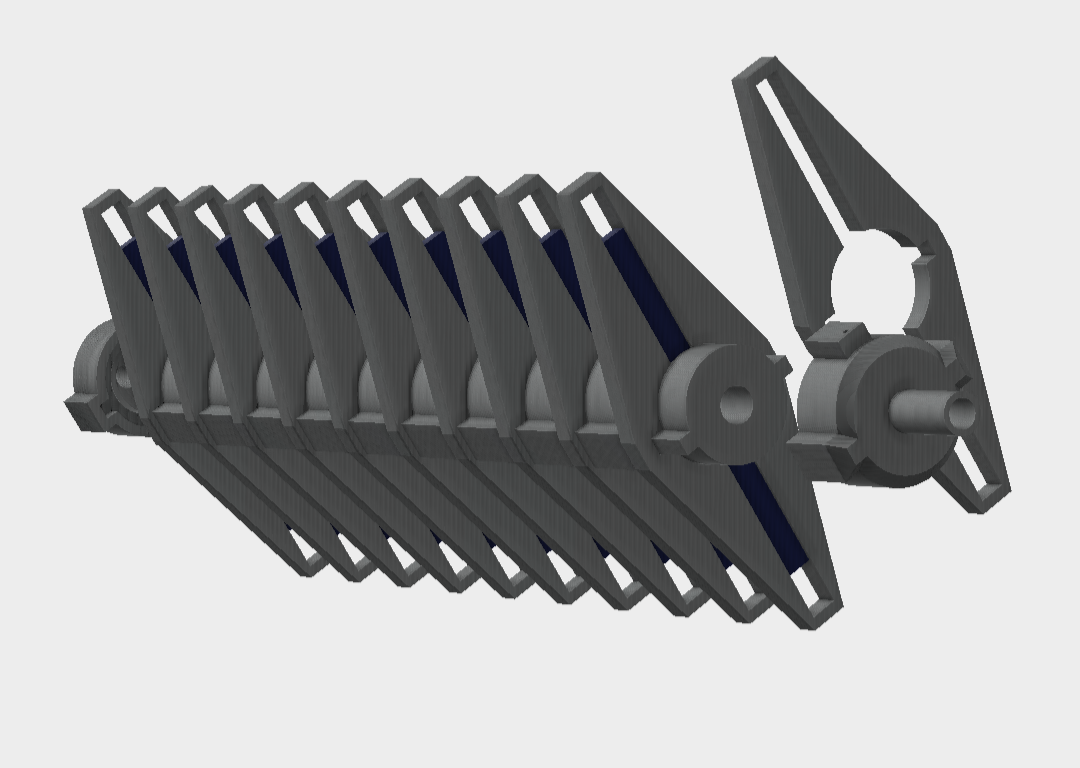
(b)CAD model of the custom-designed Faraday maser
Figure 2:Diagrams and CAD models for our free-electron maser design.
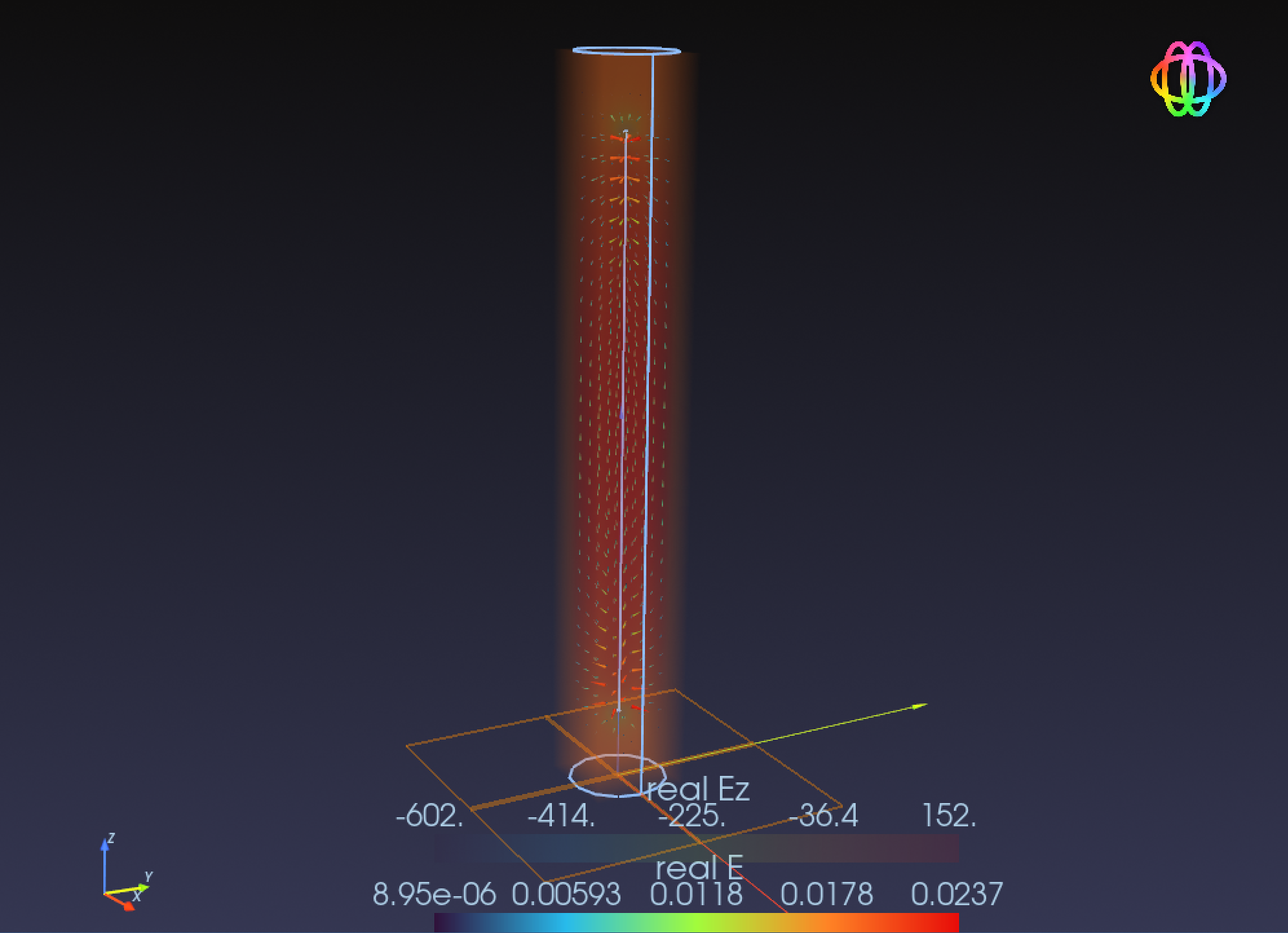
Theoretical and computational modelling of the free-electron laser involved finite-element methods to simulate the resonator, as well as numerical integration of the nonlinear equations of motion resulting from the Lorentz force. Finite-element simulations utilized the EMerge library (Fennis (2026)), an open-source computational electromagnetics’ library. The eigenfrequencies were numerically computed and compared to analytical results.
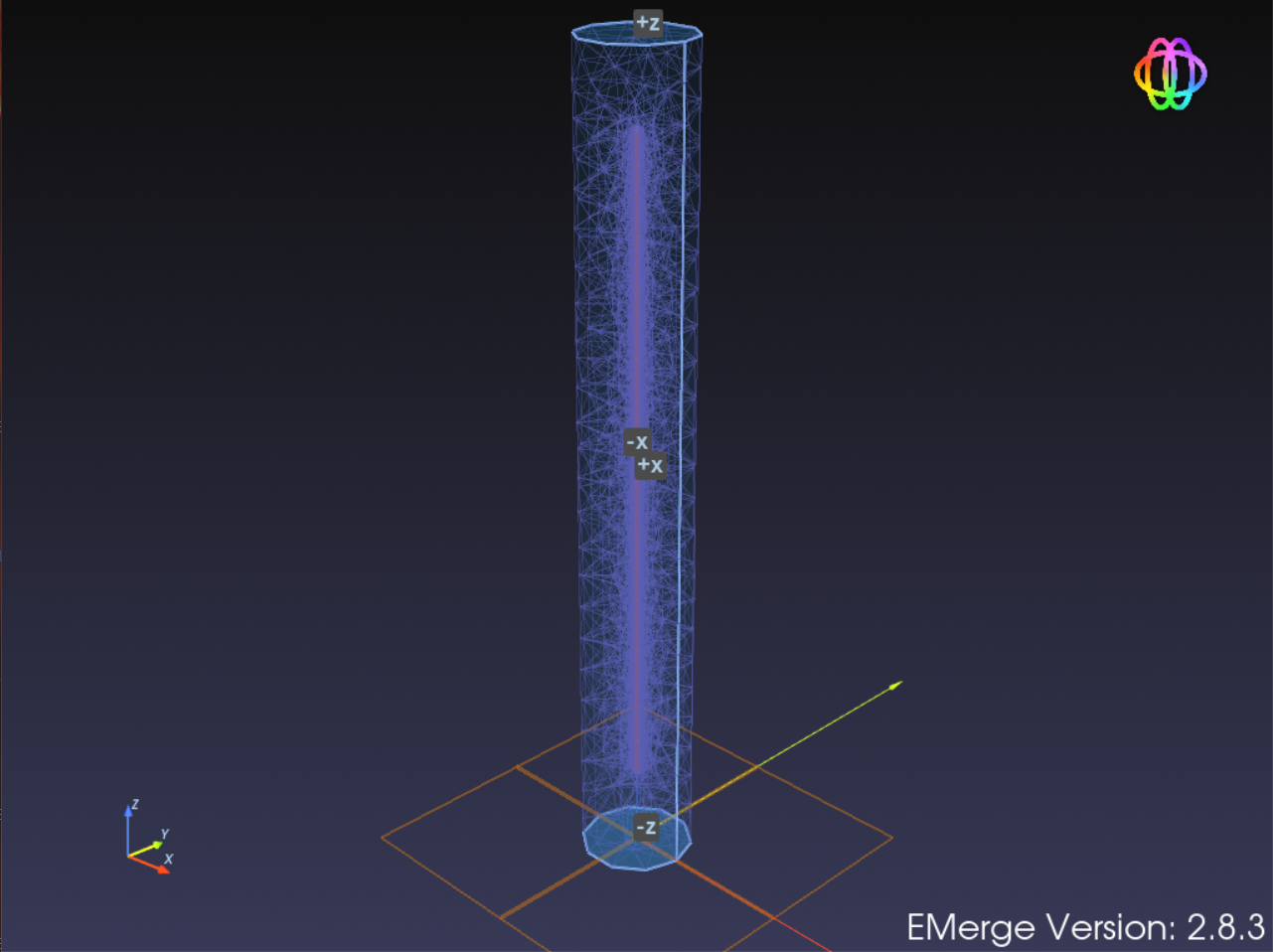
(a)Finite-element mesh
(b)Computed fundamental mode of the EM field
Figure 3:Finite-element simulations of the maser resonator. Meshing was done with gmsh and the integrated PARDISO solver in EMerge. The fundamental mode is shown here.
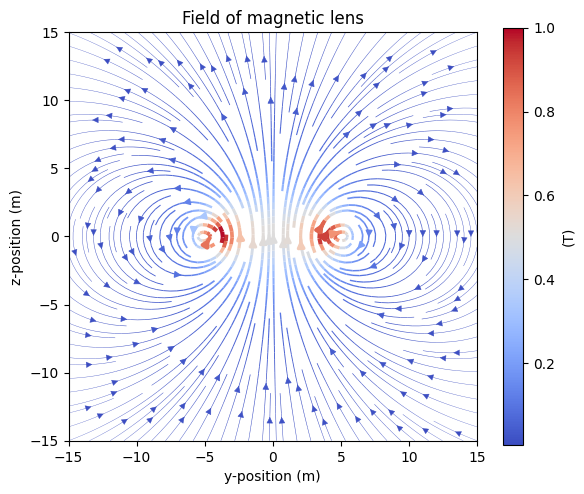
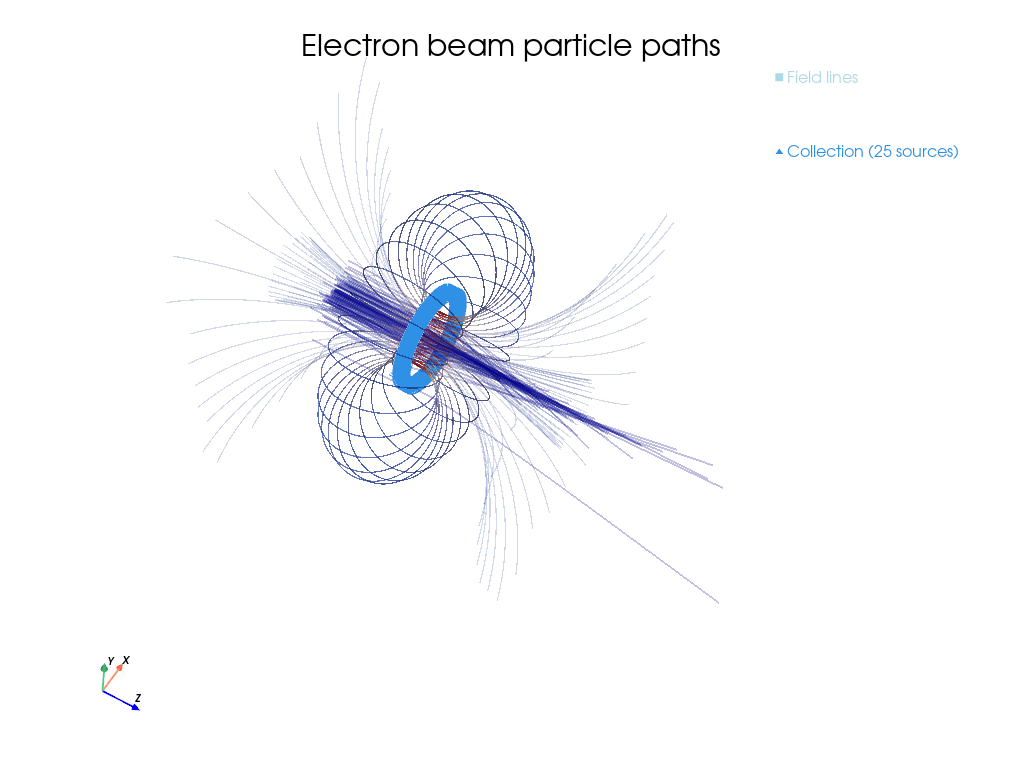
Numerical integration of the Lorentz force equations utilized custom-written codes implemented in Python for simulating the magnetic collimating lens and magnetic field of the undulator. The magnetic lens utilized the Magpylib library Ortner & Coliado Bandeira, 2020 for field computations and the relativistic Boris integrator from PlasmaPy Community et al., 2026, a community-developed open source Python package for plasma research and education. As the maser operates under vacuum conditions, vacuum modelling utilized both the NIST-developed ESTAR software Seltzer, 1993 and theoretical calculations from a Bethe-derived formula (Bethe & Heitler (1934)DeWitt (2011)) to create projections of residual air drag.
(a)Magnetic lens field, computed with Magpylib
(b)Monte-Carlo simulation of magnetic lens
Figure 4:Numerical simulations of electron beam propagation through the electron gun.
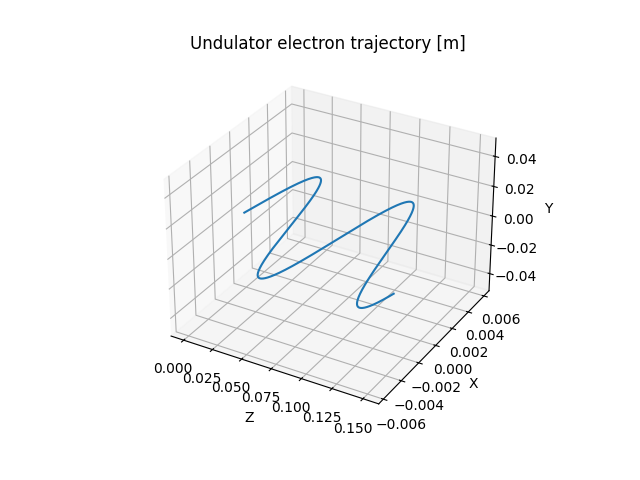
Figure 5:Simulated electron beam through free-electron maser undulator. This uses our custom relativistic beam simulator using the PlasmaPy implementation of the Boris integration scheme.
Construction of the prototype Faraday One laser is currently ongoing, with fabrication being primarily through 3D printing, enabling rapid, low-cost iteration of the free-electron maser and lowering the barrier to entry to a traditionally expensive technology. More details can be found in our open-source laser repository.
Power transmission research
Numerical simulations also were used to determine the approximate range of frequencies in which microwave power transmission from space-based power satellites would be feasible. This was essential as all-weather transmission, one of the most desirable features of space-based solar-power, would be impossible with high atmospheric attenuation. The ITU-Rpy library Portillo, 2017, an implementation of the ITU-R P.676-13 atmospheric attenuation model ITU-R, 2022, was utilized in simulations of atmospheric attenuation across the globe. Simulation results showed minimal attenuation in the L- and S-band but substantial attenuation at higher frequencies, in line with the theoretical prediction by Rayleigh scattering theory, which predicts a cross-section leading to dramatically greater attenuation at shorter wavelengths.
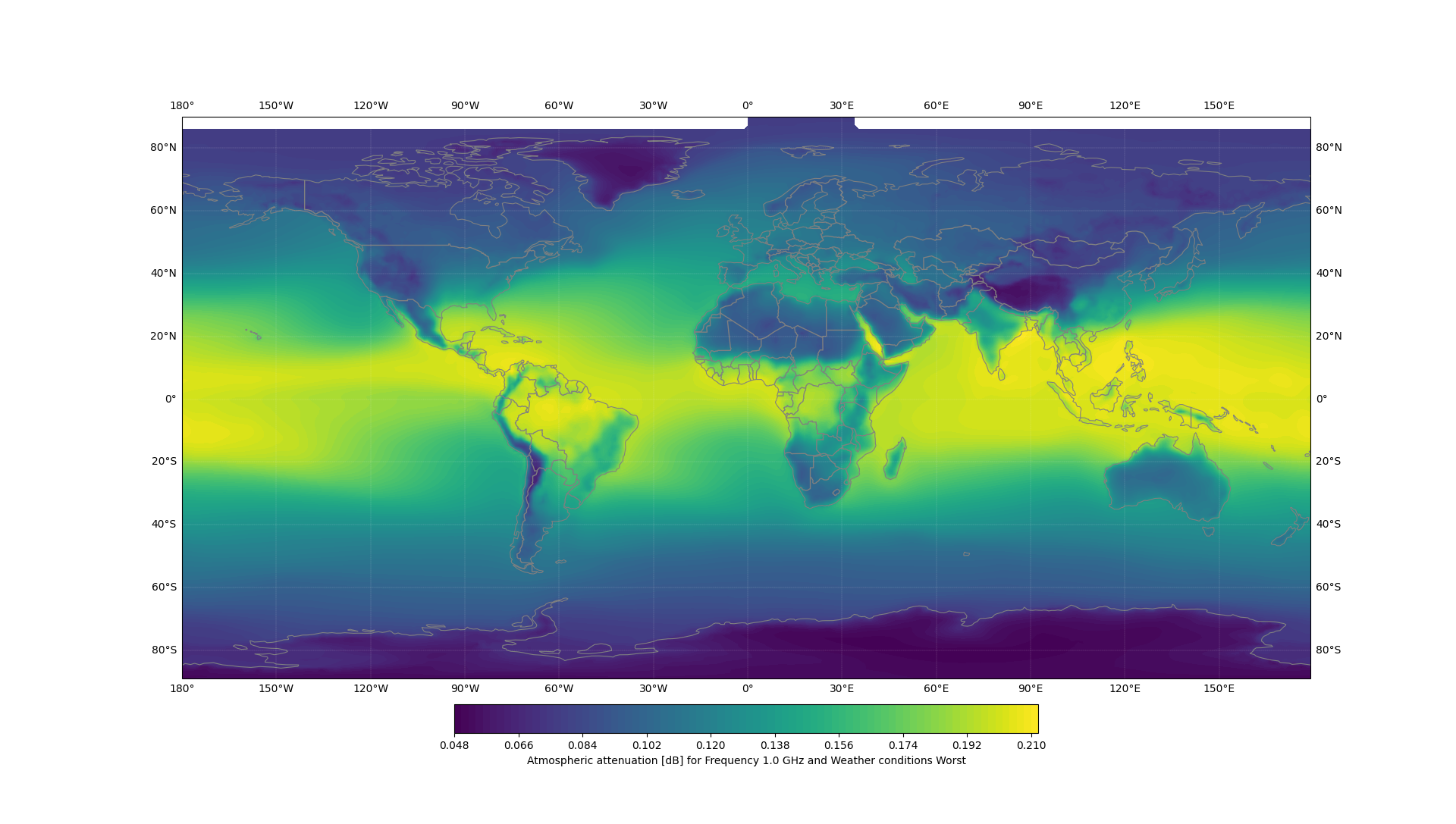
(a)1 GHz simulation of atmospheric attenuation
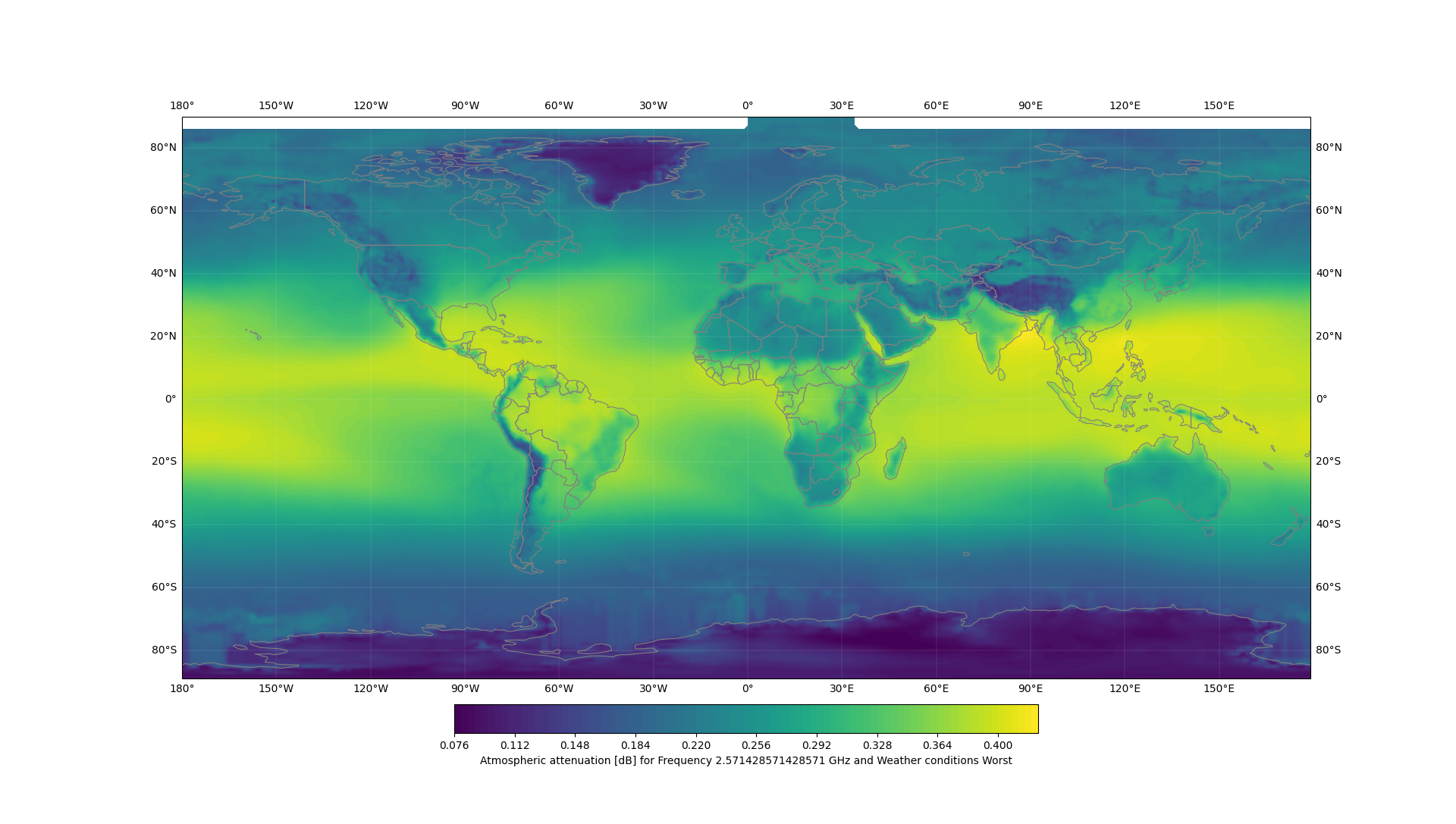
(b)2.57 GHz simulation of atmospheric attenuation
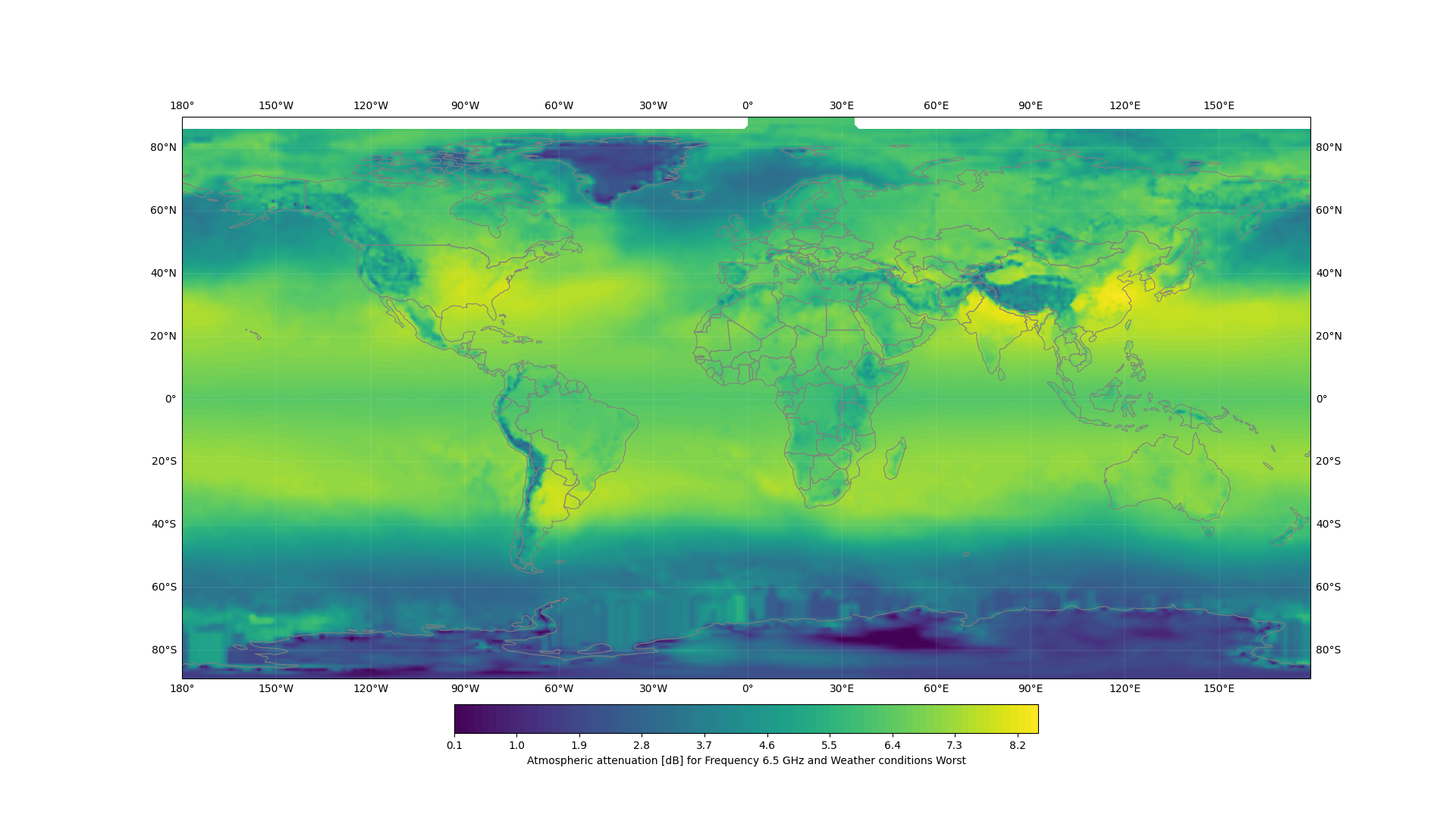
(c)6.5 GHz simulation of atmospheric attenuation
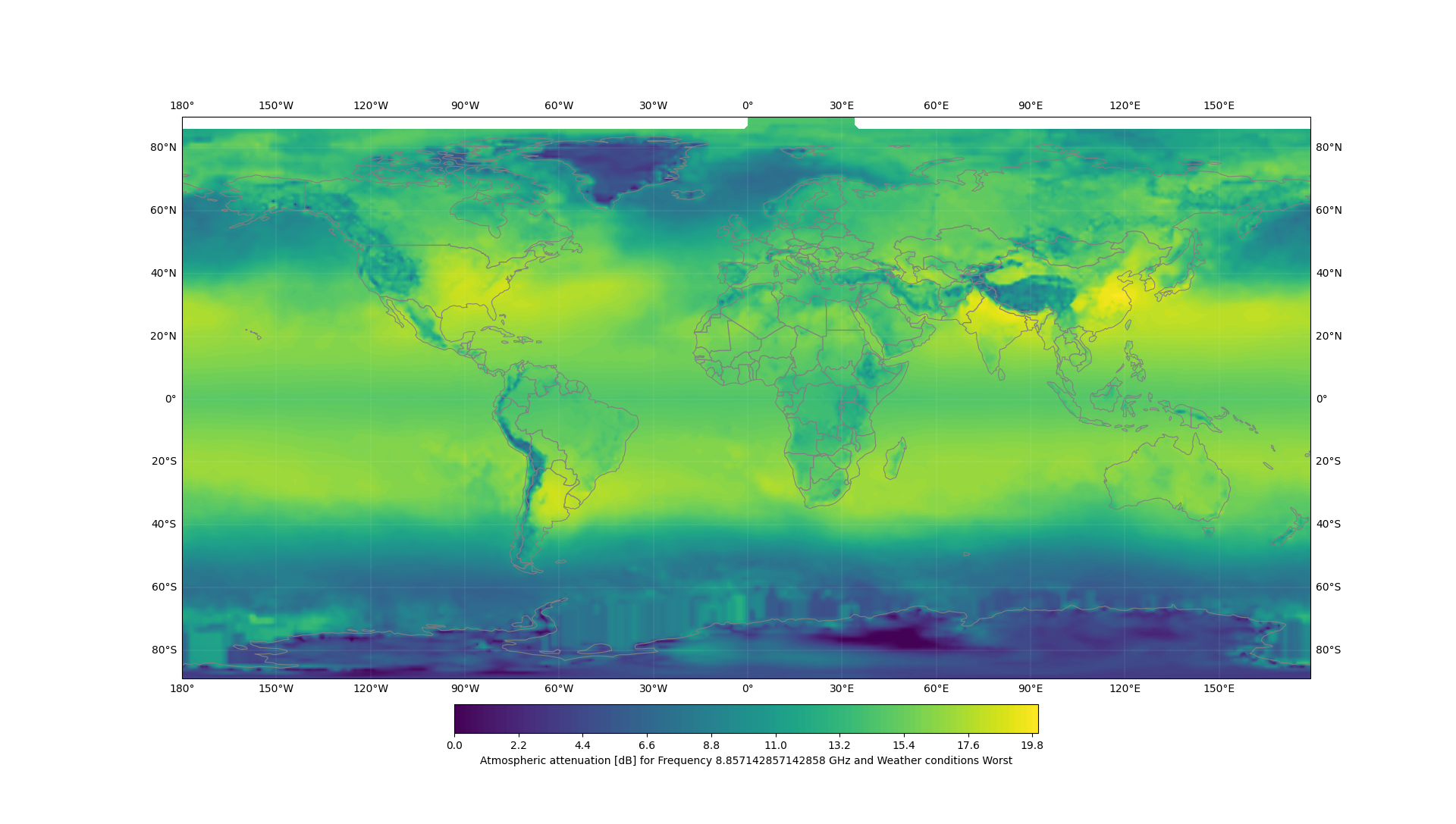
(d)8.85 GHz simulation of atmospheric attenuation
Figure 6:Simulated atmospheric microwave attenuation at L-band, S-band, C-band, and X-band frequencies (top-left to bottom-right)
Satellite development
Active development is ongoing for a lightweight satellite planned to be deployed to geostationary orbit (GEO), which houses the free-electron maser and solar mirror for solar energy harvesting and microwave power beaming. Current work primarily focuses on the development of a flight computer, with a Cortex-M3 Processor following the ARMv7-M architecture on an LM3S6965EVB board. Please see the Elara spacecraft repository for more details.
Ongoing and future work
Prospective research consists of the refinement of existing numerical simulations alongside the development of the prototype maser. More computational simulations will allow for fine-tuning the design, which in turn be used to make more accurate simulations of the system. This iterative process is expected to continue for a significant portion of time, until sufficient computational testing has yielded a highly-detailed design that can be built into functional prototypes. Ground testing and atmospheric tests are then expected to progress, with a further test-design-simulation cycle to continue adding refinements. This process is expected to continue until design finalization. As per our Charter, the entirety of the body of work made by the Project is free and open-source.
Team members
Our team is based at Rensselaer Polytechnic Institute and comes from a diverse set of backgrounds, including computer science, electrical engineering, mathematics, and applied physics. We welcome anyone to join and have regular meetings most Tuesdays and Fridays of the academic semester. There is no bar to entry, nor any necessary qualifications required.
Further information
The project website and code repositories provide more information about the project and an opportunity for anyone interested to learn more. For official inquiries, please email us at elaraproject
This is because our free-electron lasers can both be used for plasma heating in tokamaks and stellarators when operated in their typical microwave regime, as well as operation as a traditional laser for high-energy bursts in inertial confinement fusion. The latter case takes advantage of the fact that free-electron lasers are by nature tunable and can therefore generate light across the electromagnetic spectrum, meaning that the same free-electron laser can be operated in the microwave range for plasma heating, then transition to infared or UV wavelengths for inertial confinement fusion applications.
- Urbanus, W. H., Bratman, V. L., Bongers, W. A., Caplan, M., Denisov, G. G., Van Der Geer, C. A. J., Manintveld, P., Militsyn, B., Oomens, A. A. M., Poelman, A. J., Plomp, J., Pluygers, J., Savilov, A. V., Smeets, P. H. M., Sterk, A. B., & Verhoeven, A. G. A. (2001). A high power, tunable free electron maser for fusion. Fusion Engineering and Design, 53(1–4), 423–430. 10.1016/S0920-3796(00)00515-9
- Ginzburg, N. S., Kaminsky, A. A., Kaminsky, A. K., Peskov, N. Yu., Sedykh, S. N., Sergeev, A. P., & Sergeev, A. S. (2000). High-Efficiency Single-Mode Free-Electron Maser Oscillator Based on a Bragg Resonator with Step of Phase of Corrugation. Phys. Rev. Lett., 84(16), 3574–3577. 10.1103/PhysRevLett.84.3574
- Drori, R., Jerby, E., Shahadi, A., Einat, M., & Sheinin, M. (1996). Free-electron maser operation at the 1 GHz/1 keV regime. Nuclear Instruments and Methods in Physics Research Section A: Accelerators, Spectrometers, Detectors and Associated Equipment, 375(1–3), 186–189. 10.1016/0168-9002(95)01347-4
- ITU-R. (2022). Attenuation by atmospheric gases and related effects (Techreport P.676-13). ITU-R. https://www.itu.int/rec/R-REC-P.676/en
- Fennis, R. (2026). EMerge FEM. https://github.com/FennisRobert/EMerge
- Ortner, M., & Coliado Bandeira, L. G. (2020). Magpylib: A free Python package for magnetic field computation. SoftwareX, 11, 100466. 10.1016/j.softx.2020.100466
- Community, P., Murphy, N. A., Everson, E. T., Stańczak-Marikin, D., Heuer, P. V., Kozlowski, P. M., Johnson, E. T., Malhotra, R., Schaffner, D. A., Vincena, S. T., Abler, M., Addison, J., Ahamed, A. F., Alarcon, P. V., Antognetti, B., Arran, C., Bagherianlemraski, H., Beckers, J., Bedmutha, M., … Zhang, C. (2026). PlasmaPy. Zenodo. 10.5281/ZENODO.18706665
- Seltzer, S. (1993). Stopping-Powers and Range Tables for Electrons, Protons, and Helium Ions, NIST Standard Reference Database 124. National Institute of Standards. 10.18434/T4NC7P
- Bethe, H., & Heitler, W. (1934). On the stopping of fast particles and on the creation of positive electrons. Proceedings of the Royal Society of London. Series A, Containing Papers of a Mathematical and Physical Character, 146(856), 83–112. 10.1098/rspa.1934.0140
- DeWitt, J. (2011). Stopping Power of Electrons. http://handcrafted.codes/Beta/Beta.htm
- del Portillo, I. (2017). ITU-Rpy: A python implementation of the ITU-R P. Recommendations to compute atmospheric attenuation in slant and horizontal paths. GitHub. https://github.com/inigodelportillo/ITU-Rpy/